Insights

At Baycurrent, “Baycurrent Institute,” our management research institute, leads the effort to derive insights for society and businesses.
In a rapidly changing world, we delve deeply into key issues and provide knowledge to help companies open the door to the next phase.

Articles

The Japanese Chemical Industry: The Dawn of the Second Phase of Reorganization

The Japanese chemical industry is entering a new phase of structural reorganization. Companies in this industry are now shifting toward a strategy focused on selectivity and the reallocation of resources, aiming to sharpen their competitive strengths rather than simply grow in size. This paper takes a broad, industry-wide perspective to organize the key issues that the top management must confront, as well as tier-specific approaches across the value chain. By doing so, it seeks to offer insights that may help companies as they consider future industry reorganization.


View more

International Regulatory Trends on Stablecoins and Implications for Japanese Law — Legal and Practical Issues of Trust-Type Electronic Payment Instruments Based on the U.S. GENIUS Act and the EU MiCA Regulation (Part I)

In July of this year, the “GENIUS Act” was enacted in the United States, marking a significant advancement in the regulatory frameworks for stablecoins across Japan, the European Union, and the United States. As each jurisdiction has developed its own framework through distinct approaches, an environment conducive to the entry of financial institutions and technology companies is gradually emerging. This paper organizes recent international regulatory developments relating to stablecoins and examines their implications for Japan’s pioneering framework. Part I provides a comparative overview of the regulatory architectures in the United States, Europe, and Japan, while Part II addresses issues concerning supervisory implementation and challenges for private-sector deployment.

View more

The Evolution of Life Insurance: What Paradigm Shift Toward “Re-Radicalization” Is Needed for the Future? – Part 1

Life insurance was originally born as a mechanism of mutual aid within small, close-knit communities—“visible” groups of people. In recent years, however, amid shifts in consumer behavior, its value as a daily essential and social infrastructure has begun to waver. The key to reversing this trend lies in re-radicalizing life insurance—bringing it back to its origins—and doing so by embedding protection seamlessly into everyday life. This article reexamines the role that life insurance should play in the future and presents a vision in which it becomes more indispensable to society than ever before.

View more

The Evolution of Life Insurance: What Paradigm Shift Toward “Re-Radicalization” Is Needed for the Future? – Part 2

Is a “Re-Radicalized” Future for Life Insurance Truly Achievable? While initiatives that depart from conventional trajectories face numerous challenges, many of these barriers can be overcome with existing technologies. By examining pioneering case studies, this article explores mechanisms for integrating insurance seamlessly into everyday life and identifies practical approaches to make such integration a reality. Furthermore, it considers the feasibility of monetization, aiming to sharpen the clarity of new business models for life insurance.

View more

Books

Building a High-Growth Organization

Five Core Principles for Breaking Free from Gradual Decline and Achieving Sustainable Growth (Nikkei BP)

Can an organization transform a state of normalcy into one of urgency? Guided by this question, we analyzed companies that continue to achieve high growth and identified the shared “perspectives, ways of thinking, and behavioral patterns" that underpin their success. We distilled these into what we call the "Five Core Principles".  We then present a change-management approach for embedding these "Five Core Principles" within an organization. In addition, we conducted interviews with thirteen executives to validate the applicability of these principles.

Sharpening the Issues

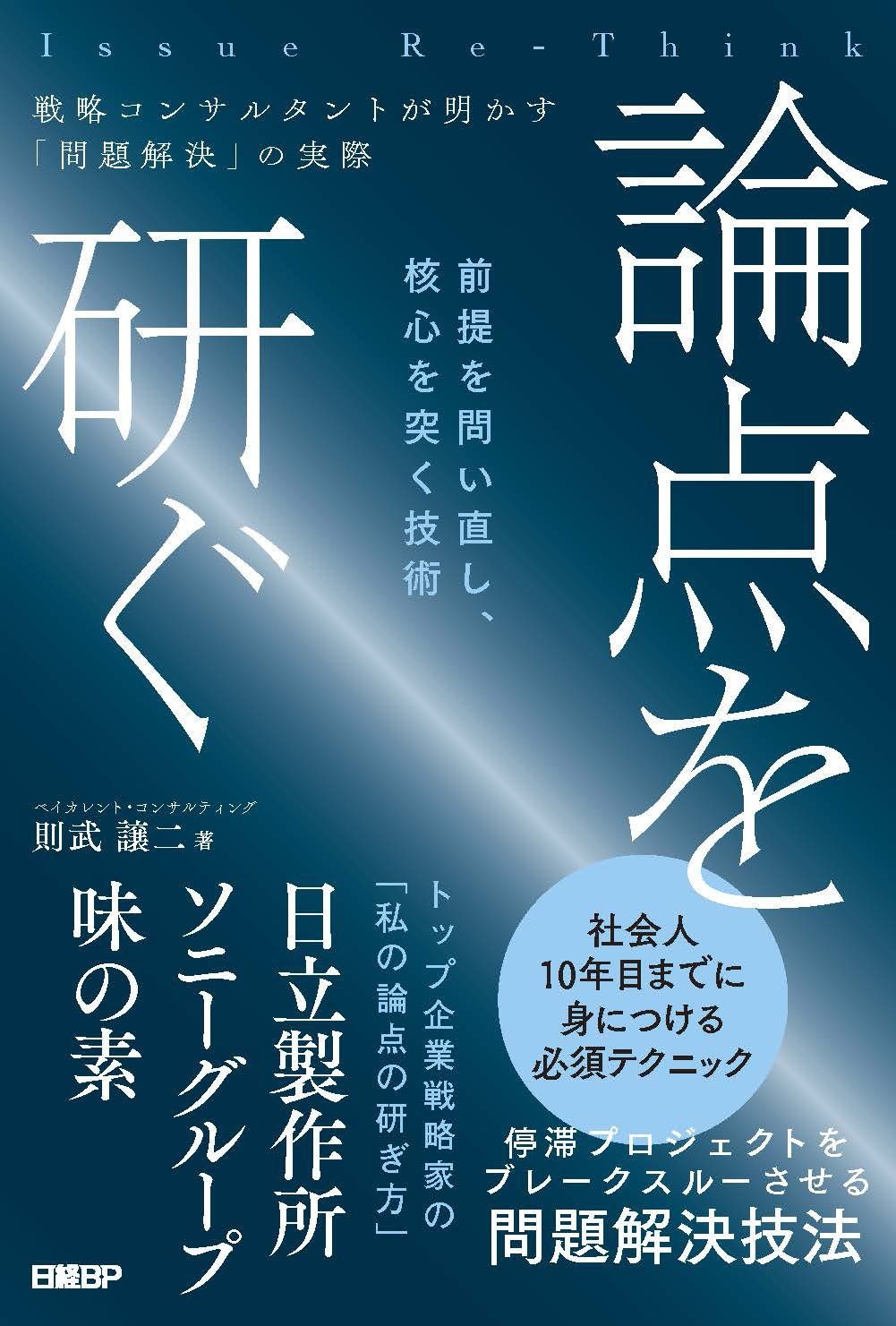
The art of questioning assumptions and getting to the heart of the matter(Nikkei BP)

The key to a breakthrough in a stalled project lies in the “issue setting" of problem solving. Although it is possible to set up some kind of “issue“, the initial point of contention may not always capture the essence of the problem. That is why it is important to keep reviewing and "sharpening" the issues. In this book, we will thoroughly explain the highly difficult process of "sharpening the issues" to find the issues that really need to be solved, along the five steps to do so.

SX Sustainability Management Practice

(Nikkei BP)

Sustainability management is rapidly increasing in importance, and if a company lags behind in SX (Sustainability Transformation), there is a high possibility that the survival of the company itself will be in jeopardy. So how do companies actually proceed? Baycurrent, which has supported SX in many Japanese companies, thoroughly explains specific theory for practicing sustainability management with corporate case studies.

Impressive CX

"10 new strategies" and "7 signposts" for Japanese companies (Toyo Keizai Inc.)

The core of CX (Customer Experience) is to continue to exceed customer expectations, and all companies should aim for CX that impresses their customers. We looked at CX from various angles, such as consumer changes occurring in the modern digital society and discussions that cut from cutting-edge academic research. In addition, it organizes "10 new strategies" and "7 signposts" for Japanese companies to realize Impressive CX, and is a must-read book for all business people